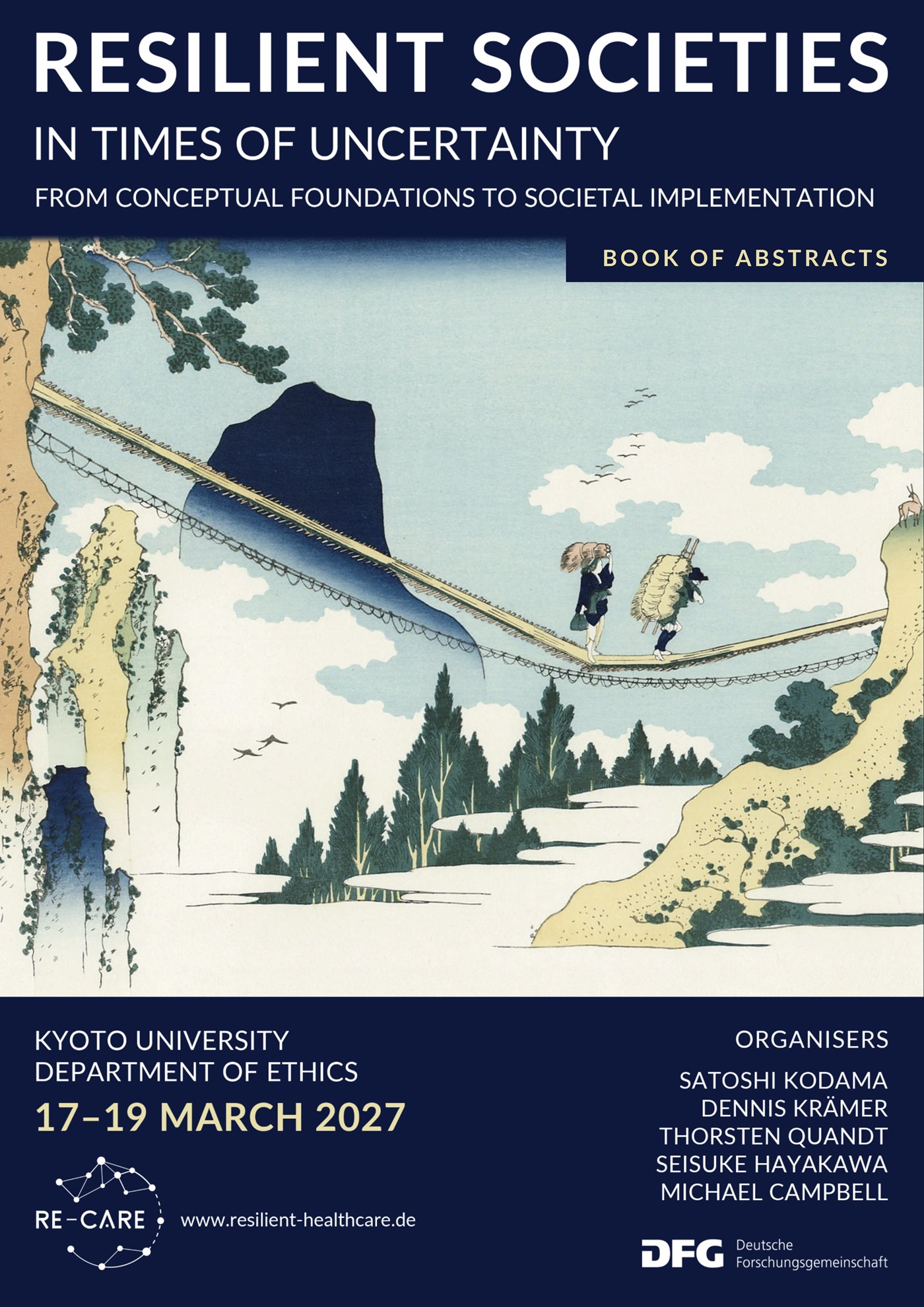
The book of abstracts for the #3 RE-CARE conference “Resilient Societies in Times of Uncertainty – From Conceptual Foundations to Societal Implementation” is now available. It brings together the abstracts of two keynotes and nineteen talks by researchers from Japan, Germany and Canada.
Keynotes
Satoshi Kodama (Kyoto) asks what resilience means in super-aged and shrinking societies such as Japan. Taking the 2024 Noto Peninsula earthquake as an example, he argues that recovery to the pre-disaster state is no longer a self-evident goal, and that resilience must also be understood as adaptation and transformation. This leads to what he calls the resilience planning paradox: the more seriously a society prepares for future crises, the more it risks undermining trust, legitimacy and solidarity.
Thorsten Quandt (Münster) addresses democratic societies facing a “polycrisis” and deliberate information threats from outside and within. Drawing on his own research into online disinformation and toxicity, he outlines the current landscape of these threats and offers conceptual frameworks and practical ideas on how societies can build resilience against them.
Overview of the talks
Panel 1 — Health System Resilience: Data Governance and Social Preparedness
Shigeto Yonemura (Tokyo) shows that personal genome data could already inform decisions such as hiring or school admissions, while the law in Europe and Japan covers only a few of these uses, and proposes further legal rules. André Karch (Münster) reports on three linked infrastructures set up in Germany after COVID-19 – a nationwide modelling network, a platform for rapid epidemiological studies and an interface between public health institutions and academia – and on what it takes to keep them ready between pandemics. Bernd Hellingrath and Adam Widera (Münster) present the CareFlow project, which explores how cross-border patient flows can help healthcare systems in European border regions share capacity. Yoshinori Nakata (Tokyo) examines whether Japan’s 2024 reform limiting physicians’ overtime has changed healthcare productivity.
Panel 2 — Governing Crises and Resilience: Institutions, Autonomy, and Social Imaginaries
Sou Hee Yang (Takasaki) asks when breaches of quarantine, isolation or closure orders during COVID-19 in South Korea and the United States could legitimately be punished as crimes. Davide Viero (Duisburg-Essen) uses a survey experiment to study how social workers in Germany, Portugal, Spain and Taiwan exercise discretion when deciding on long-term care benefits. Yukio Sakurai (Yokohama) compares voluntary assisted dying in Canada and the Netherlands and describes an “autonomy paradox”, in which more individual choice goes hand in hand with more bureaucratic governance. Dennis Krämer (Münster) examines apocalyptic narratives, from religious prophecy to scenarios of climate catastrophe and AI, as a recurring social form through which groups deal with crises, create meaning and shape collective identities.
Panel 3 — Truth, Trust, and Health: Fostering Societal Resilience in the Digital Age
Kyoko Kuwahara (Tokyo) argues that Japan, with its long history of rumours in the wake of disasters, needs a whole-of-society approach to information resilience that goes beyond a national security framing. Jean-Christophe Boucher and Guillaume L’Hermie (Calgary) trace how the 2025 culling of around 300 ostriches after an avian flu outbreak in British Columbia escalated online into an international political controversy. Chris Tenove (Vancouver) shows how unaccountable influencers, rather than government bodies or established media, dominate vaccine narratives in Canada, and how trust attacks on health communicators erode public health authority. Saïd Unger, Johanna Klapproth, Thorsten Quandt and Dennis Krämer (Münster) map international research on resilience to disinformation, its core themes, collaborations and interdisciplinary blind spots.
Panel 4 — Theoretical and Normative Foundations of Resilience
Gabriel Bartl (Berlin) sets resilience between cybernetic fantasies of control and deliberative crisis governance, and makes the case for a reflexive, participatory concept with the social dimension at its centre. Joschka Haltaufderheide (Greifswald) proposes humanity, solidarity and impartiality as ethical principles for designing AI-supported predictive technologies in public health crises. Azher Hameed Qamar (Münster) draws on research with migrants in Sweden and Germany to develop a framework in which resilience is not something people have, but a process they go through, shaped by inequalities and institutional encounters.
Panel 5 — Technological Resilience: AI, Cybersecurity, and Digital Infrastructures
Susanne Brucksch (Tokyo) examines how Japanese municipalities use AI in welfare services such as elderly care, disability support and child protection, drawing on a newspaper analysis and a case study from Tokyo’s Shinagawa ward. Annie Kurz (Stuttgart) looks at digital detox as a strategy for coping with uncertainty, and at the paradox of relying on technologies to create distance from technologies. Ken Ogata (Tokyo) compares how major countries regulate the response to cyberattacks on healthcare information systems and the role governments play in it. Takanori Fujita (Tokyo) discusses the legal and ethical conditions for turning medical AI in Japan from pilot projects into resilient healthcare infrastructure.
The book of abstracts is available for download: Resilient Societies in Times of Uncertainty — Book of Abstracts (PDF, 3.1 MB)